
Tyre Strategy Impact on F1 Betting: The Variable Most Punters Underweight
 Available in US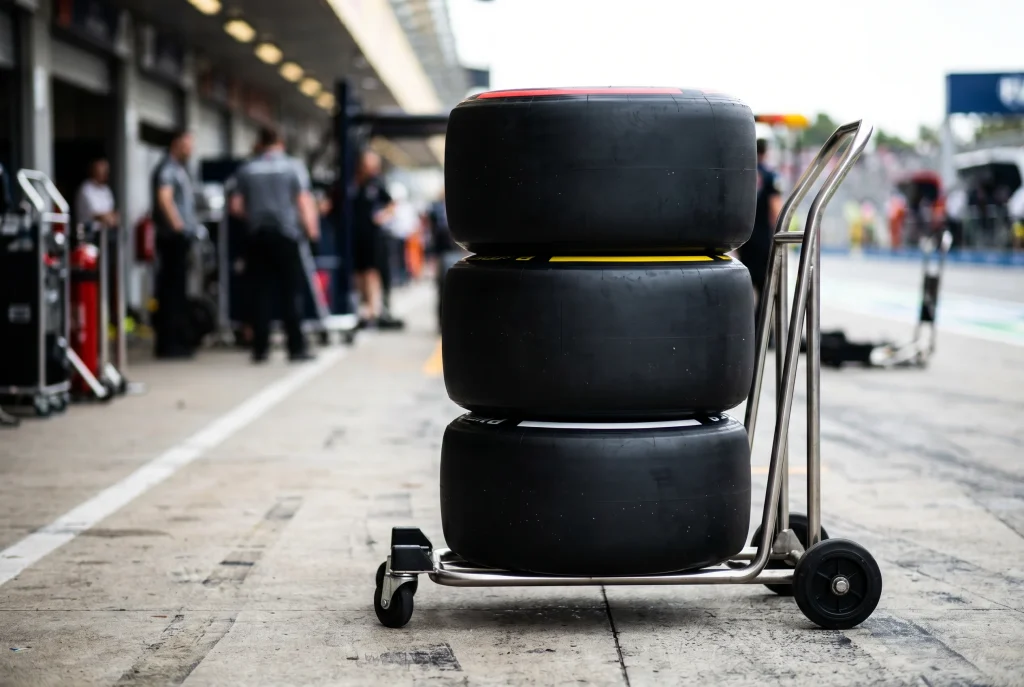
The strategist on the pit wall is making betting decisions for you
The race I cite most often when people ask me about tyre strategy is the one where the leader pitted with 18 laps to go, came back out in fourth, and won by 12 seconds. The strategists on the pit wall made a call based on degradation data nobody outside the team could see in real time. The bookmaker’s race-winner market reacted three laps later. The punters who understood tyre strategy were three laps ahead of the operator’s pricing model. That kind of asymmetry is rare in F1 betting — and tyre strategy is where it concentrates.
The 21% of UK online gamblers who place live bets (37% among 18-to-24-year-olds) are the audience that profits most from tyre-strategy literacy. Pre-race tyre allocation is public information; in-race tyre choice is partly inferred and partly visible; the resulting strategic windows are where the live market produces its largest price movements. The £596 million UK real-event handle in the most recent quarter (up 5% year-on-year) concentrates around races where tyre-strategy variance is highest.
Tyre Strategy Impact on F1 Betting — More on this topic at where to bet on f1.
The three compounds and what they actually do
F1 brings three compound choices to each race weekend, designated soft, medium, and hard. The naming is relative — the soft compound at Spain is harder than the medium at Monza, because the compounds are chosen specifically for each circuit. The headline truth is that softer tyres go faster but wear out sooner; harder tyres last longer but deliver less peak grip.
The compound choice affects three betting-relevant variables. Stint length — how many laps a driver can run on each compound before performance drops below the next driver’s pace on a different compound. Pit-stop window — when in the race a driver must pit, which determines whether the undercut or overcut strategies are viable. And final-stint pace — whether the closing laps reward fresh tyres on a softer compound or worn tyres on a harder compound.
The race-day strategy is essentially a series of compound choices and stint-length calculations. The bookmakers price the race-winner market based on assumed strategies; the actual strategies sometimes diverge from the assumption, and the price movements reflect the divergence.
The undercut and overcut — the two trades that move prices
The undercut is the strategy of pitting earlier than the driver ahead, taking fresh-tyre advantage, and using the lap-time gain to leapfrog the driver when they pit later. The overcut is the reverse — staying out longer than the driver ahead, banking the warm-tyre advantage, and pitting after the original lead-driver has cooled their fresh tyres in traffic.
Each strategy works under specific conditions. The undercut works when tyre degradation is high and fresh-tyre pace is significantly faster than worn-tyre pace. The overcut works when tyre warm-up is slow and the new tyres take 2 to 3 laps to come up to optimal temperature.
The betting implication is that the cars best suited to undercut strategy are different from the cars best suited to overcut strategy. A car with good cold-tyre warm-up is undercut-favoured; a car with weak cold-tyre warm-up but strong long-run pace is overcut-favoured. Identifying these characteristics from Friday and Saturday practice data is one of the highest-EV preparations I do for race-day betting.
One-stop versus two-stop — when the race shape changes
The strategic decision that produces the largest in-race price movement is the one-stop versus two-stop call. Some races allow only one strategy reliably; others permit both, and the choice across the field becomes the decisive variable. A two-stop race rewards fresh-tyre pace and rewards drivers who can attack at the restarts. A one-stop race rewards tyre management and consistent lap-time delivery.
The pre-race pricing usually assumes the most common strategy. When the actual strategy differs — driven by safety car deployment, weather, or unexpected degradation patterns — the prices move significantly. The 2025 season’s three drivers tied on seven wins each, decided by countback on a two-point margin, included multiple races where the strategy call decided the result and the bookmaker pricing reacted late.
Safety car deployment and the strategy reset
A safety car deployment in the middle of the race resets the tyre-strategy calculation. Drivers who were committed to a two-stop suddenly find a free pit-stop window — the safety car neutralises the field, and a stop costs only the lost positions during the lapping, not the usual 20-second pit loss in green-flag conditions.
The safety-car-driven strategy reset is one of the most predictable producers of price movement in live F1 betting. The leader of the race, comfortably in front, can become the third-favourite within 90 seconds of a safety car deployment, simply because their tyre strategy is now sub-optimal relative to drivers who can pit free. The operator pricing usually catches up within the safety-car window, but the lag is exploitable.
Safety car deployment rate in current F1 runs at roughly 50% across all races — though circuit-specific rates vary from Monaco’s 80% to Bahrain’s 30%. The strategic-reset implication is built into pre-race tyre-strategy planning; the in-race execution is where the betting opportunity lives.
Tyre allocation rules — the part nobody reads
The FIA tyre allocation rules require drivers to use at least two of the three compounds in a dry race — one of the most overlooked rules among recreational punters. The rule means a driver cannot run the entire race on a single compound. A driver starting on hard tyres must pit for either medium or soft at some point; a driver starting on soft must eventually pit for medium or hard.
The implication for betting is that strategy options are constrained by the allocated set distribution. A driver who used their soft compounds in qualifying may have only one set of soft tyres remaining for the race, limiting the strategic flexibility on Sunday. Tracking the allocated set usage across qualifying — public information published by the FIA — is a useful pre-race preparation step.
The 78% of F1 fans wanting more Sprint rounds will see six Sprint weekends in 2026 — and Sprint weekends have a separate, tighter tyre allocation that further constrains strategic options. The Sprint format compresses the strategy variance into a shorter race, which sometimes produces more predictable outcomes than the conventional weekend.
How tyre strategy interacts with race-winner pricing
The bookmaker’s race-winner price is a probability-weighted summary of likely outcomes. When the most-likely strategy is clear, the price reflects that strategy’s expected outcome. When the strategy is contested — multiple viable approaches with different drivers favoured under each — the price reflects a blend.
The asymmetry to look for is the situation where one driver is heavily favoured under one specific strategy. If that strategy is implemented, the driver should be priced shorter than the current market shows. If a different strategy emerges, the driver should be priced longer. The current price is wrong in one direction or the other; the work is identifying which.
This is where Friday and Saturday practice data pays off. The long-run stints in practice reveal which compounds last and which drivers can manage them. Combining this with the qualifying compound choices (visible on the broadcast) and the pre-race weather forecast produces a strategy probability picture that the public market does not fully reflect.
The single habit that improves tyre-driven betting
The one habit I would recommend to any F1 punter is to read the official tyre allocation press release before each race. It takes 90 seconds. It shows which compounds each driver has remaining for Sunday — and the constraint pattern that follows. The recreational punter does not read it; the disciplined punter does. That 90-second difference produces meaningful pricing edge across the season.
See also F1 Driver Form Statistics and Betting.
For a related view of how race-day market dynamics interact with strategic variables, my piece on cash out F1 bets covers the in-running market behaviour where tyre-strategy variance produces the largest cash-out value swings.
Created by the "Apexodd" editorial team.
