
Cash Out on F1 Bets: How It Works and When It's a Trap
 Available in US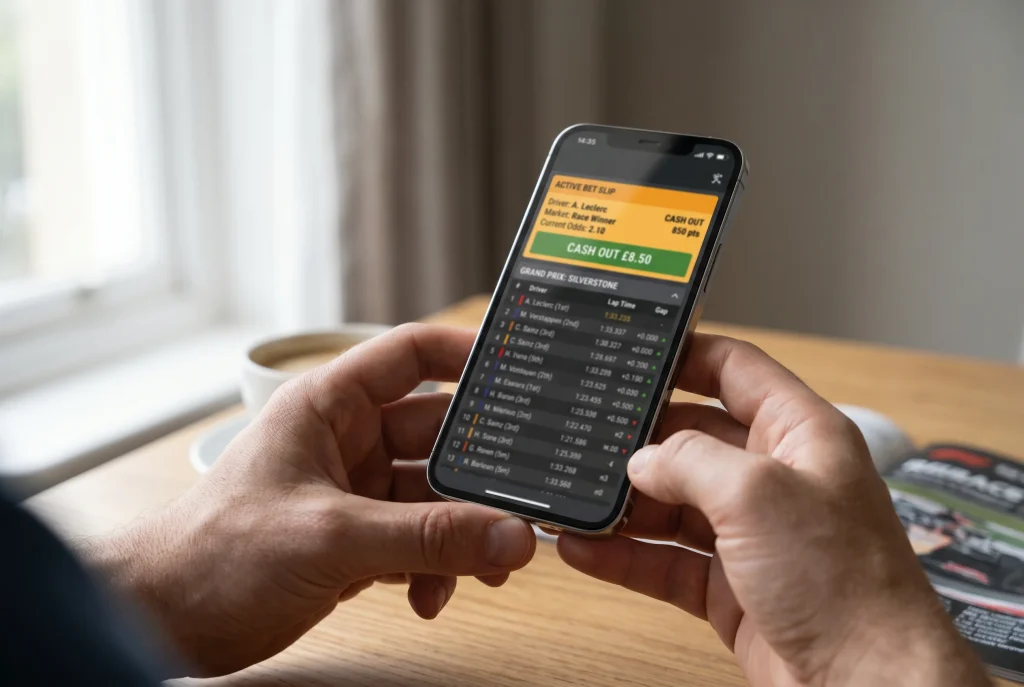
What cash-out actually represents — bookmaker’s buyback offer
Cash-out is a buyback offer from the bookmaker. That is the single sentence that demystifies the whole product. The price you see flashing on your bet slip mid-race is not a fair-market settlement and it is not a courtesy. It is an offer to repurchase your active wager at a price the operator believes is profitable for them. Whether it is profitable for you depends entirely on what you know that the model does not.
The product became mainstream in the UK around 2014 and has since become a near-universal feature on live sportsbook platforms. F1 cash-out is now offered on most race-winner and head-to-head markets at the major UKGC-licensed brands. Live and in-play betting overall has grown into the leading segment of the global sports betting market, and cash-out is the single most-used tool inside that segment. The reason the product exists is not philanthropy. It exists because it monetises the punter’s risk aversion.
Cash Out on F1 Bets — More on this topic at where to bet on f1.
The Mechanics: How a Cash-Out Price Is Calculated
The cash-out price is generated by three inputs running through the operator’s pricing engine. Input one is the current live price of your selection — if you backed a driver at 5/1 pre-race and that driver is now leading on lap 30, his current live price might be 4/9. Input two is the model’s confidence in that live price, which usually correlates with how recently it last refreshed against the actual race situation. Input three is the operator’s cash-out margin, which is layered on top of the implied fair price as a guaranteed profit.
That margin is what makes cash-out a structurally unfavourable product for the long-run punter. Take a worked example. Your original £20 wager at 5/1 has a notional fair-value payout of around £80 (return of stake plus £100 profit) if the driver wins, and £0 if he loses. Mid-race, with the driver leading and the model assigning him a 70% chance of winning, the fair expected value of the bet sits at around £84. The operator’s cash-out price will be lower — typically around £72 to £76 — and the difference is the operator’s margin.
If you take the cash-out, you have effectively paid the operator £8 to £12 to remove uncertainty. That can be worth it occasionally. It is not worth it as a habit.
Partial Cash-Out and Auto Cash-Out
Partial cash-out lets you take a portion of the value off the table while leaving the remainder of the wager live. You might cash out 50% of the position at fair-ish value while keeping the other 50% running for the full payout. The maths underneath is still subject to the operator’s margin, but only on the portion you cash out — the live portion remains a normal active bet.
This is the most defensible use of the product. It converts an all-or-nothing wager into something closer to a managed position, similar to how a trader might scale out of a profitable trade. The drawback is that the partial-cash-out interface is fiddly on most apps. You have to specify the cash-out portion (sometimes as a percentage, sometimes as a cash figure), confirm, and wait for the slip to re-render. During a fast-moving race phase, that delay can cost you the price you saw on screen.
Auto cash-out is the automated version. You set a target return — say, “cash out at £40” — and the platform triggers the cash-out automatically when the available figure reaches that threshold. Useful for punters who cannot watch the race live but want to lock in a defined return. Useless if the trigger fires during a safety car and the live price snaps to a level you would not have chosen manually. Around 21% of UK online gamblers place live bets during events, and a meaningful share of them use auto cash-out as a risk-management tool — sometimes with results they did not anticipate.
Race Situations Where Cash-Out Is Defensible
Three race scenarios make cash-out a reasonable consideration rather than a tax on your future returns.
The first is when you have information the model does not yet have. If you can see from live timing that your driver is rapidly losing pace — degrading tyres, dropping into a DRS train, struggling with car balance — and the cash-out price has not yet adjusted, taking the offer captures value before the model catches up. This window is narrow and closes quickly, but it is real.
The second is when the model is overconfident in your selection. After a safety car bunches the field, the operator’s algorithm sometimes treats the consolidated gap as a stronger signal than it actually is. A driver running second after a safety car has not necessarily improved his chances of winning by as much as the cash-out price suggests; he might just be closer to the leader. If your read of the race says the lead is more durable than the model thinks, the cash-out is overpriced from the operator’s perspective — which is to say, attractive from yours.
The third is when your position is severely compromised but not yet dead. A DNF risk that is rising — say your driver radios in with a temperature warning — can be hedged via cash-out before the eventual retirement zeros the bet entirely. You give up the chance of a miracle finish for guaranteed recovery of part of the stake.
When Cash-Out Costs You Value
The trap is the opposite scenario. You cash out a leading position to “secure the win” with twenty laps remaining. The operator’s price reflects roughly 80% confidence in your selection. You take the cash-out at 80% of the would-be payout, minus margin. Twenty laps later your driver crosses the line first and you have left meaningful value on the table.
The behavioural pattern is well-documented. Punters cash out positions where the expected value of holding still exceeds the cash-out offer because the psychological cost of seeing a lead evaporate is higher than the financial cost of accepting the operator’s margin. The aggregate effect, over enough wagers, is a measurable drag on long-run returns.
A Worked Example: Cash-Out During Safety Car
Pre-race £10 on Driver X at 8/1. On lap 32, X is running third, safety car deployed for debris. Cash-out offered at £18. Fair expected value: around £21. The £3 gap is the operator’s margin on this specific moment. Defensible if you fear the safety car restart will reshuffle the order; expensive if you believe X will hold the position.
See also Price Boosts and Bet Boosts on F1.
Cash-out is a product, not a service. It is sold to you for a margin, the same way every other bookmaker offering is. Use it when you have information edge or genuine hedging need; ignore it the rest of the time. For more on the live-betting environment in which cash-out lives, see my fuller treatment of in-play and live F1 betting.
Written by the editors at Apexodd.
