
Price Boosts and Bet Boosts on F1: When Boosted Odds Are Real Value
 Available in US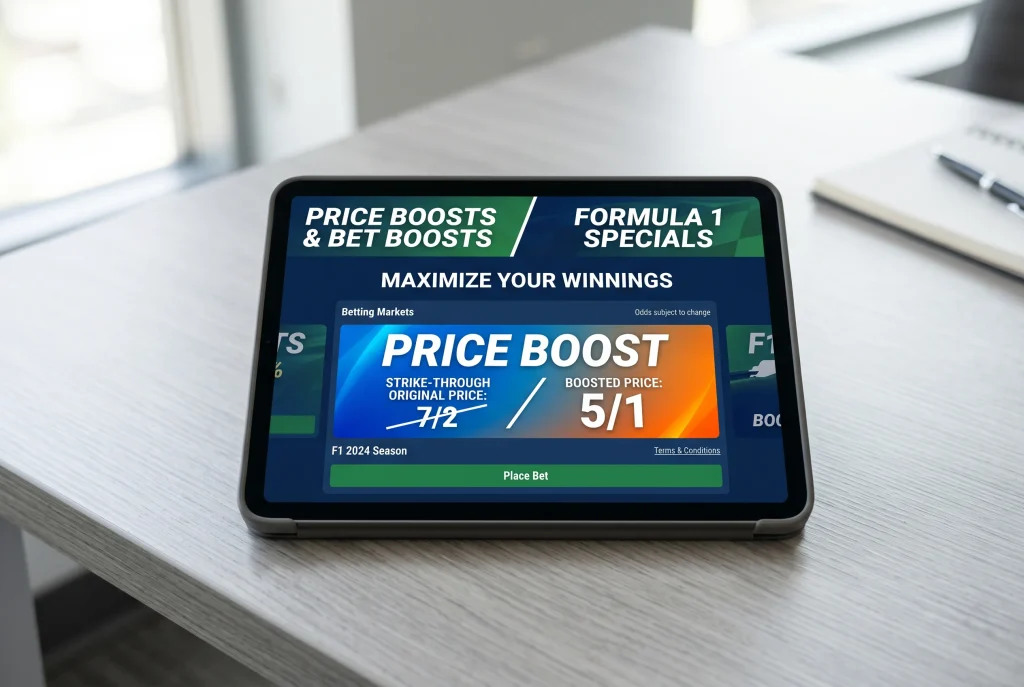
Boosted prices are a sales tool — and sometimes a real edge
Almost every Saturday morning of a Grand Prix weekend, I see at least one price boost worth taking and at least one that looks like a gift but is structurally worse than the standard price elsewhere on the same market. The split between the two is roughly 30/70, and the only way to tell which is which in real time is to know the underlying maths.
Boosted prices exist because operators need a reason to put their brand at the top of your attention queue. The economics are simple — a price boost is a marketing line item, not a generous mistake — but the execution varies enormously across UK operators. A well-constructed boost gives the punter a small edge and the operator a high-value customer interaction. A poorly-constructed one is just standard pricing in louder packaging.
Price Boosts and Bet Boosts on F1 — More on this topic at where to bet on f1.
How Bookmakers Construct a Boost
The construction starts with a base market price. Take a driver currently at 6/1 to win the race. The operator’s pricing team identifies the boost candidate, applies a fixed lift — say to 8/1 — and publishes the boost. That 8/1 is now 33% higher than the unboosted price, which sounds substantial.
What you do not see is the market context. If three other UK operators are offering 7/1 on the same driver, the boost is only marginally better than competitive pricing. If two operators are offering 6/1 and the rest 5/1, the 8/1 boost is a genuine outlier. The boost is meaningful in absolute terms only relative to where the market actually trades, which is why a quick cross-bookmaker check should always precede taking a boost.
The second layer of construction is the stake cap. Almost every boost carries a maximum stake — commonly £25 to £100. The operator can afford to lift the price because the volume of liability per ticket is contained. A 33% odds enhancement on a £25 stake represents around £10 of theoretical extra payout per ticket if the bet wins; over a customer base of thousands, the operator might book a five-figure marketing cost for a Sunday afternoon’s worth of brand exposure. Real-event betting in the UK generated £596 million in gross gaming yield in the most recent reporting quarter, and price boosts are a recurring tactical investment within that flow.
Typical F1 Boost Shapes
Four shapes dominate the F1 boost landscape on UK books. Each has a different value profile.
The single-driver outright boost is the most common. “Driver X to win, was 7/1, now 9/1.” Clean structure, easy to compare against other operators. Value depends on the price gap to competitive offers, full stop.
The H2H matchup boost is the most analytical. “Driver A to beat Driver B in qualifying, was 4/5, now evens.” These are valuable when you have a strong read on the matchup. The margin in H2H markets is narrower than in outrights — typically 4% to 6% — so a 25% lift on the price represents a clear and quantifiable edge.
The combined-selection boost — sometimes labelled a “bet boost” rather than a price boost — packages multiple legs at a sweetened price. “Driver A pole, Driver A to win, fastest lap to Driver A — combined 25/1, was 18/1.” These look generous because the headline number is bigger. The real question is what the fair price of the combined selection actually is, factoring in the correlation between legs. Some of these are positive expected value; many are not.
The “any driver from a given team” boost is the trap shape. “Either teammate to win at 5/1.” The natural temptation is to compare 5/1 against the price of the better driver alone. The honest comparison is against the combined implied probability of either driver winning, which is usually closer to 7/2. The 5/1 boost on the team-double is often slightly worse than fair value, dressed up to look generous.
Comparing Boosted Price Against the True Market
The discipline is straightforward but few punters do it. Before taking any boost, open one of the major odds aggregators and check what the market is offering for the same selection. If the boost price exceeds every other UK operator’s standard price, take it. If it matches or undershoots competitive pricing, ignore it — you are paying attention to the marketing without receiving the edge.
The other check is the implied probability. Convert the boost price to implied probability (1 divided by decimal odds, expressed as a percentage). Compare that to your own estimate of the selection’s chance of winning. If the implied probability is lower than your estimate, the boost is positive expected value by your model. If higher, it is not. The motorsport betting market globally is estimated at around $8.6 billion in 2023 and projected to reach roughly $22 billion by 2032 — that growth is exactly what makes price-boost competition between operators sharpen each season.
Stake Caps and Account Eligibility
Stake caps on boosts are usually disclosed at the point of bet placement but sometimes buried in the offer terms. Common ranges are £10 minimum cap, £100 maximum, with the average sitting around £25. The cap restricts how much of the boost value you can capture per ticket.
Account eligibility is where boosts get politically uncomfortable. Operators use predictive models to identify which accounts receive boosted prices and which do not. Sharp accounts — those who consistently beat the market — often see boost offers throttled or removed entirely. Recreational accounts receive boosts more frequently because they are statistically less likely to extract systematic value from them. This is not a UK-specific phenomenon but it is more pronounced in markets with high operator competition.
If boosts stop appearing in your account, it usually means the operator’s model has classified you as a value-aware customer. The polite name for this is “stake restriction adjacent”. The practical implication is that you might need to spread activity across several accounts to maintain consistent access to boost offers across a season.
Boost Fatigue: When to Ignore Them
Every boost you take is an active decision. Eight or nine boosts a weekend is too many. The cognitive cost of evaluating each one outweighs the marginal edge available, and the discipline of checking every comparison erodes after the fourth or fifth check. I aim for two boosts per Grand Prix weekend at most.
See also F1 Acca Tips.
Price boosts are worth treating as an occasional edge rather than a default behaviour. The two or three boosts a weekend that genuinely beat the market are worth taking with stake. The rest are operator marketing in costume. For more on how the standalone outright prices that underlie these boosts behave through a season, see my piece on F1 outright and futures markets.
Published by the Apexodd team.
