
How to Read an F1 Betting Slip: Decoding the Numbers and Terms
 Available in US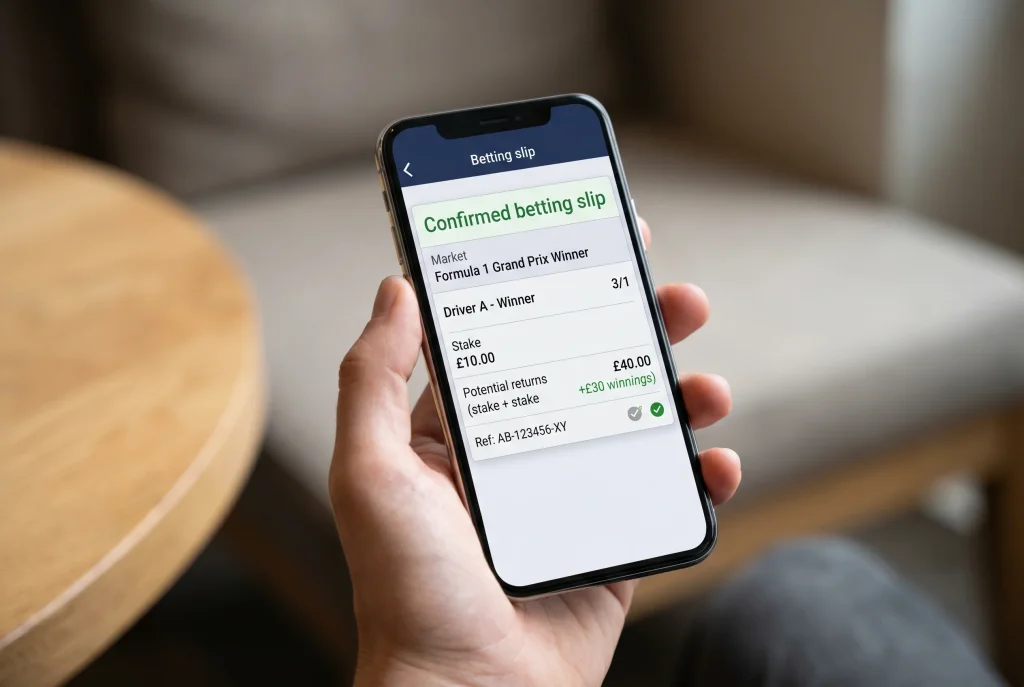
The slip is a contract — read it like one
The first time I confidently placed an each-way bet on an F1 driver, I misread the place terms and got paid out at a quarter of what I expected. The mistake was not the bet itself — it was failing to read the slip properly before confirming. The betting slip is a contract between you and the operator. Every detail on it determines what you win and when you win it.
The 13.5 million active UK gambling accounts include a surprising share of punters who skip past the slip details and confirm bets without checking the place terms, the each-way fraction, or the boost type. Every misread is paid for in money. The 28% of UK F1 fans who placed an online sports bet in the past year deserve to know exactly what they are agreeing to before tapping confirm.
How to Read an F1 Betting Slip — More on this topic at where to bet on f1.
The five fields that decide everything
Every F1 betting slip — pre-race, in-play, accumulator, bet-builder — contains the same five core fields. They appear in different visual orders across operators, but the substance is identical:
- Selection: the driver or team you are backing, and the specific market (race winner, podium, top six, H2H, etc.)
- Odds: the price at which the bet is being struck, in decimal or fractional format
- Stake: the amount you are wagering
- Potential return: stake plus winnings if the bet wins
- Bet type: single, double, accumulator, each-way, system bet
Most of the misreads happen in fields four and five. The potential return often looks right at a glance but conceals a place-terms condition (one-quarter the odds, three places paid only) that changes what you actually receive. The bet type field sometimes defaults to each-way when you intended a win-only bet, doubling your stake.
Decimal versus fractional — what 4.0 actually means
The shift to decimal odds in UK markets has not eliminated fractional pricing — it has layered both formats on top of each other. A driver priced at 4.0 in decimal is the same price as 3/1 in fractional, but the calculation for return differs. Decimal 4.0 means a £10 stake returns £40 total (stake plus winnings). Fractional 3/1 means a £10 stake wins £30 in addition to the £10 stake, returning £40 total. Same outcome, different framing.
The slip should display whichever format you have selected in your account settings. Operators that switch formats mid-slip — showing decimal in one place and fractional in another — produce more reading errors than the same-format slips. If your slip mixes formats, switch to one or the other in settings and reconfirm before placing.
Each-way mechanics — the most misread field
Each-way betting splits your stake into two parts: half on the win, half on the place. A £10 each-way bet is actually a £20 total stake. The slip should show this clearly, but some operators display only the per-way amount, making the total stake easy to underestimate.
The place terms are the second variable. For F1 outright markets, the typical place terms are one-quarter the odds for the top three positions, sometimes extended to four or five places on a price boost. A driver priced at 12.0 decimal each-way for top three places means: win bet at 12.0, place bet at 12.0 minus one paying one-quarter the odds for a top-three finish. The arithmetic is: place return on £10 stake = 1 + (11 x 0.25) = 3.75 multiplier, so £37.50 returned if the place bet wins but the win bet does not.
The £150 affordability check threshold introduced by the UK regulator means slips for stakes near or above that level often trigger additional verification. The slip itself does not always indicate this — the verification appears at the confirm-bet step. Knowing the threshold matters because it changes the flow of a high-stake bet from “tap to confirm” to “submit documents and wait”.
Accumulators and bet builders — combined slips
An accumulator slip combines multiple selections into a single bet. The combined odds multiply, and the slip shows both the individual selections and the combined price. A four-leg F1 accumulator with each leg at decimal 2.0 produces combined odds of 16.0 — every leg must win for the bet to pay out.
The bet-builder slip is structurally similar but pulls multiple selections from a single race. Pole-position-winner plus race-winner plus fastest-lap combined on one driver might price at 25.0 versus the unrelated multiplication. The price reflects the correlation between selections — bookmakers reduce the combined price below pure multiplication when the events correlate.
Reading these slips means checking three things: every selection is correct, the combined odds are what you expected, and the stake is the total stake (not per-leg). Mis-selecting a leg in a bet-builder can shift the combined price by 30% to 50%, and the change is sometimes hard to spot in the line-by-line slip view.
Price boosts, free bets, and bonus markers on the slip
A price boost increases the displayed odds for a specific selection. The slip should show the original price and the boosted price separately. If only the boosted price appears, the boost is harder to verify against the standard market. A boost from decimal 4.0 to decimal 5.0 — a 25% improvement — is meaningful; a boost from 3.5 to 3.6 — a 3% improvement — is not.
Free bet stakes appear with a tag indicating that the stake itself is the free bet credit. Free bet returns usually exclude the stake — a £10 free bet at decimal 4.0 returns £30 (winnings only), not £40. The slip should specify “free bet stake not returned” or similar. If the slip is ambiguous, the safe assumption is that the free bet stake is excluded from the return.
Bonus markers on accumulator slips indicate when a multi-leg bet qualifies for an acca insurance or acca bonus offer. The terms — minimum legs, minimum odds per leg, maximum bonus amount — appear in the slip footer or in the offer details. Confirming a slip without checking these terms is how punters miss out on bonuses that would have applied.
What the slip does not tell you
The slip does not show the operator’s own margin on the market, which is the implied difference between the sum of probabilities across all outcomes and 100%. For F1 outright markets, the typical margin runs at 110% to 120% — meaning the operator is taking a 10% to 20% cut from the true probabilities. The slip is silent on this. You see only the price offered to you, not the cushion the bookmaker has built in.
The slip also does not tell you the cash-out value at any moment. That figure appears in the “my bets” or “open bets” view, not on the original slip. The cash-out option is a live, dynamic price calculated against the in-running market. The original slip is a static record of what you bet, at what price, and for what return — not what the bet is currently worth.
Three small habits that prevent misreads
Three habits eliminate most slip-reading errors. First, always check the bet type before tapping confirm — single, each-way, accumulator, bet-builder. The default sometimes changes between sessions. Second, check the place terms when betting each-way — quarter odds versus fifth odds, top three versus top four. The difference is meaningful. Third, screenshot the slip before confirming for any stake above your normal range. A screenshot is the record if the operator’s slip view changes later.
See also F1 Midfield Value Bets.
The slip is the document. Read it the same way you would read a phone contract — slowly, on the first time, and again before signing. For the broader context of where slips fit into a full betting workflow, my piece on cash out F1 bets covers the live-market side of what happens after the slip is confirmed.
Prepared by the Apexodd editorial staff.
