
Responsible Gambling and F1 Affordability Checks: What UK Punters Need to Know
 Available in US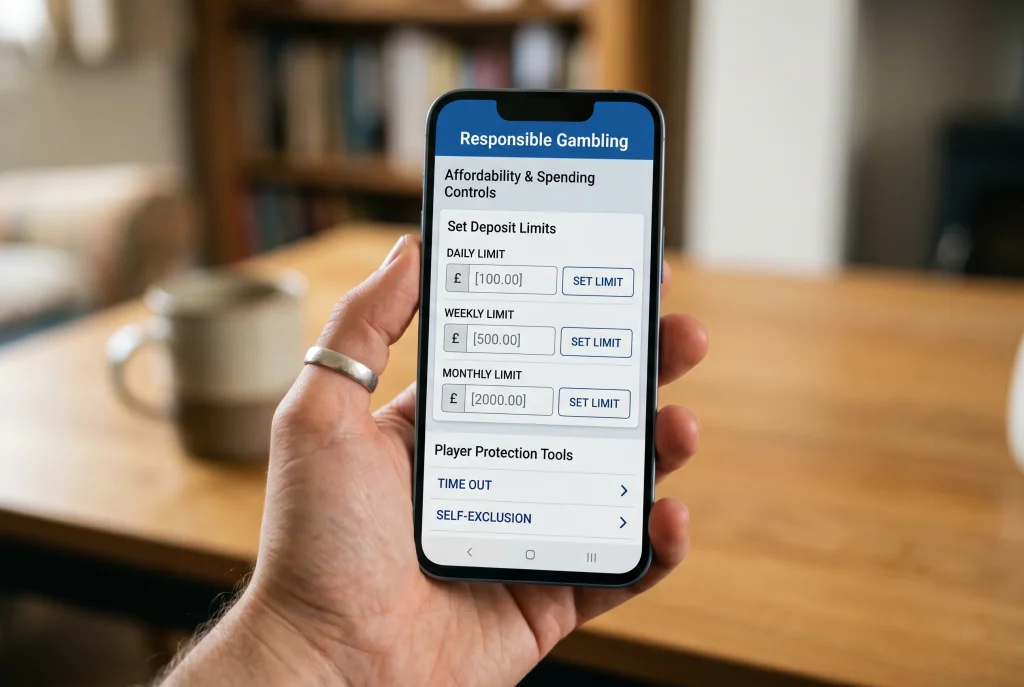
The framework that changed how UK punters actually bet
The first time I hit an affordability check on a Friday-night accumulator, I was annoyed. The bookmaker wanted three months of bank statements before I could place a £200 stake on a Sprint weekend. Once I worked through it, I came to a different view: the framework exists because the alternative — unlimited stakes with no checks — produces the kind of large-scale harm that the UK regulator is mandated to prevent. The practical effect on F1 punters is real, and worth understanding before you hit a check at the wrong moment.
The 13.5 million active UK gambling accounts include 22.5 million regular gamblers across the population — a quarter of UK adults bet in some form during the year. The Gambling Commission’s affordability framework applies to all UK-licensed operators, and F1 betting sits inside it like any other vertical. The 28% of UK F1 fans who placed an online sports bet in the past year are part of the audience covered.
Responsible Gambling and F1 Affordability Checks — More on this topic at where to bet on f1.
How affordability checks work in practice
The headline number is £150. Net loss thresholds approaching this level — across rolling 30-day or 90-day windows — typically trigger the first affordability touchpoint. The exact threshold and trigger pattern vary by operator, but £150 is the regulatory benchmark that most operators have built around.
The check itself usually starts as a soft check — open-source data, credit reference verification, sometimes a brief affordability questionnaire. If the soft check produces a green signal, the punter usually continues without further interruption. If the soft check produces an amber or red signal, the operator escalates to a hard check — bank statements, payslips, or other documented evidence of income and spending capacity.
The hard check is the source of most friction. It typically requires 60 to 90 days of statements, sometimes payslips, occasionally a P60. The submission process varies by operator — some have integrated bank-data connectors that pull statements automatically with consent; others require manual document uploads. The processing time runs from 24 hours at the fastest end to 7 to 10 days at the slowest, depending on operator capacity and the complexity of the check.
What triggers a check during an F1 weekend
F1 weekends produce specific patterns that can trigger affordability checks even at moderate stakes. A spike in betting volume across Friday-Saturday-Sunday — practice, qualifying, race — produces a concentrated activity profile that operator monitoring systems flag for review. A punter who places six £30 bets across three days has done £180 of stake activity, even if the net loss is much lower.
Live betting amplifies this. The 21% of UK online gamblers who place live bets (rising to 37% among 18-to-24-year-olds) generate dense bet patterns during a race — sometimes a dozen or more small stakes across 90 minutes. The volume of bets, separate from the financial loss, can trigger pattern-based reviews even when the total stake is small.
The motorsport betting market’s projected growth from $8.6 billion in 2023 to $22 billion by 2032 — a 156% expansion — will accelerate the operator monitoring sophistication. The systems that flag activity patterns are becoming more granular, not less, and the F1-specific betting patterns are visible in the data.
The deposit limit — the tool I actually use
Every UK-licensed operator must offer deposit limits as a self-set tool. The limit is a hard cap on how much you can deposit into the account across a chosen window — daily, weekly, monthly. The limit can be raised only after a cooling-off period (typically 24 hours), which is the mechanism that prevents impulsive increases.
My deposit limit is set well below my discretionary income — meaningful enough to back the bets I want to place across a normal week, not so high that a single bad weekend can damage my finances. The discipline of setting the limit at the start of the season, and not raising it mid-season, is what makes the tool effective. Operators do not enforce this; the punter has to.
The 78% of F1 fans wanting more Sprint rounds will see 24 races with six Sprint weekends in 2026 — meaning more total betting opportunities across the season than in previous years. The expanded calendar increases the per-month betting volume potential, and the deposit limit becomes more relevant as the calendar density grows.
Time-out and self-exclusion — the harder tools
Time-out is a temporary self-imposed pause — typically 24 hours, 7 days, 30 days, or longer. Self-exclusion is a longer-term block — 6 months, 1 year, 5 years, or indefinite. Both are available across every UK-licensed operator, and indefinite self-exclusion across operators is available through GAMSTOP, the centralised registry.
The time-out tool is the one I see used most often by responsible punters. Setting a 7-day time-out after a losing weekend prevents the chase pattern that is the most reliable producer of further losses. The operator cannot withhold the time-out — once requested, it must be applied immediately. Reactivation after the time-out requires explicit re-confirmation.
Self-exclusion is a more serious step. Once activated, the account is locked for the chosen period and cannot be reactivated until that period has fully elapsed. The GAMSTOP integration means a self-exclusion at one operator can be extended across all UK-licensed operators with a single registration — the cleanest enforcement mechanism if you have decided to stop entirely.
The credit card ban and its quiet impact
The UK credit card gambling ban took effect in April 2020. Since then, no UK-licensed operator can accept credit card deposits. The intent was to stop the most damaging pattern — borrowing money to bet — at the deposit step, before the bet ever occurred.
The practical effect on F1 punters is that all deposits must come from debit cards, bank transfers, or e-wallet sources that themselves cannot be funded by credit. The funding chain is checked end-to-end by responsible operators; any deposit that traces back to a credit source is rejected. The protection is more effective than it appears at first glance because it eliminates a specific harm pattern at the source.
Where F1 betting fits the responsible framework
F1 betting is not categorised as a higher-risk vertical in the UK regulatory framework — it sits in the standard sports betting category alongside football, horse racing, and tennis. The affordability thresholds and self-exclusion tools are the same. The difference is in pattern density — F1 weekends produce concentrated activity, with live betting spikes that can look statistically similar to higher-risk patterns even when the actual behaviour is moderate.
The Liberty Media 2025 financial reporting showed F1 revenue at $3.9 billion (up 14%) and 1.83 billion global TV audience — engagement is rising, and the betting volume on F1 is rising alongside it. The UK share of that audience, with 162 million viewer-hours on Sky Sports F1 across 2025 (under-35 viewership up 120% since 2019), reflects a young and growing audience that the responsible-gambling framework is specifically designed to protect.
Three practical habits that keep punters out of trouble
Three habits separate the punters who never have a problem from the ones who eventually do. First, set a deposit limit at the start of the season and do not raise it. Second, track total stake — not just net loss — across each F1 weekend, because the stake volume is what operators monitor. Third, take a 7-day time-out after any losing weekend, no exceptions. The discipline of forced separation prevents the chase pattern that causes most damage.
See also Tyre Strategy Impact on F1 Betting.
The framework is not a punishment — it is a structure. Working with it produces better outcomes than working around it. For more on the practical side of operator interactions and what the betting workflow looks like in the UK regulated environment, see my piece on PayPal F1 betting sites UK, which covers the payment side of the regulated workflow.
Prepared by the Apexodd editorial staff.
