
Las Vegas GP Night Race Betting: Reading the Newest Street Circuit on the Calendar
 Available in US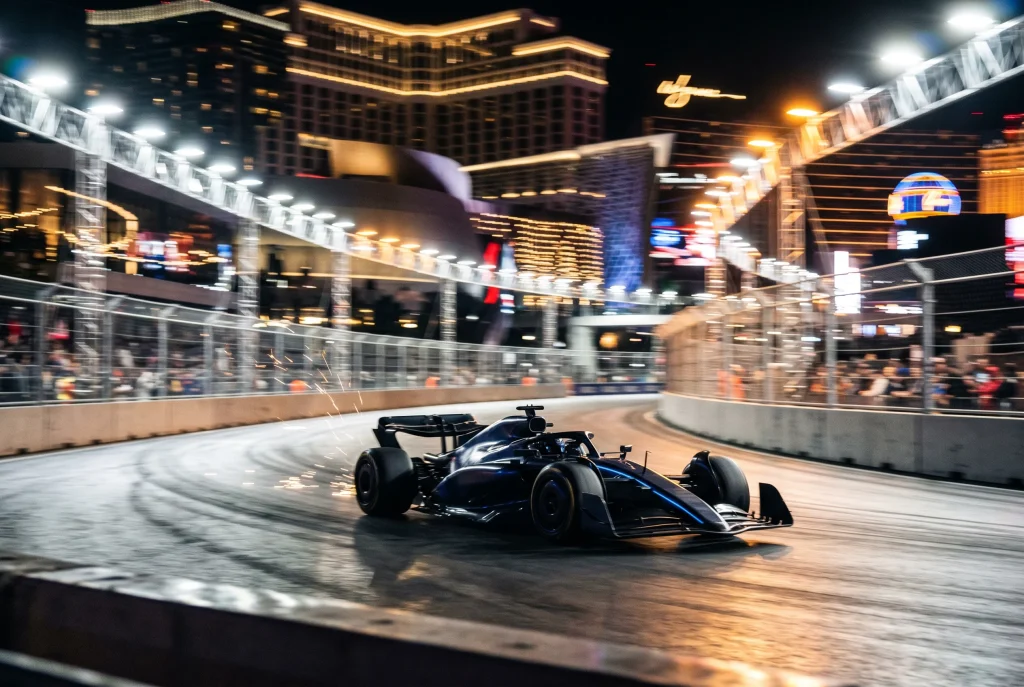
The race that broke its own pricing model
The first Las Vegas Grand Prix produced betting outcomes that almost no operator had priced accurately. The circuit was new, the cold-track conditions were unique on the calendar, and the night-race format added variables that the standard pre-race modelling did not capture. Two seasons in, the operators have caught up substantially — but the residual pricing uncertainty at Las Vegas is still larger than at established rounds. For UK punters watching at midnight UK time, the race rewards preparation that the late-evening crowd often skips.
The Las Vegas GP airs in the small hours of UK Sunday morning — a Saturday-night race in the US time zone. The 16.7 million UK F1 fans, with under-35 viewership up 120% since 2019 on Sky Sports F1, include a meaningful share who watch live regardless of the hour. The 21% of UK online gamblers placing live bets — 37% among 18-to-24-year-olds — produce concentrated overnight volume around the Las Vegas in-play markets.
Las Vegas GP Night Race Betting — More on this topic at where to bet on f1.
The cold-track problem and how it shifts pricing
Las Vegas in November runs at evening temperatures in the low teens Celsius — and the track surface cools further during the race. Cold-track conditions produce two F1-specific problems: tyres do not warm up properly, and grip degrades through the race rather than recovering. This is the opposite of most F1 circuits, where the track warms during the day and grip increases.
The implication for race-day pricing is that the cars with weak tyre-warm-up profiles — usually identifiable from the season’s earlier rounds — struggle disproportionately at Las Vegas. Drivers who depend on aggressive tyre warm-up to extract qualifying pace can find themselves outside the top six on Sunday. Drivers with patient, gentle tyre warm-up styles can over-perform.
The pre-race form data from earlier in the season needs adjustment for the cold-track factor. A driver who finished third in the championship overall might be priced as the third favourite for Las Vegas — but if their car’s tyre-warm-up profile is poor, the actual win probability is lower than the third-favourite price implies.
The street-circuit character — overtaking but limited
The Las Vegas Strip section is fast — a 1.9 km straight at 220 mph plus — but the rest of the circuit is a tight street layout with walls close to the racing line. Overtaking happens, but it concentrates in two or three specific zones rather than spreading across the lap as it would at Monza or Spa.
The pole-to-win conversion at Las Vegas has settled around 40% to 50% in early data — moderate, similar to Silverstone or Spa, well below Monaco’s 60% to 70%. The implication for race-winner betting is that the pole-sitter is favoured but not dominantly so. Drivers starting second through fifth have meaningful win probability, with the values often loose enough to produce pricing edges.
The 2025 season’s three drivers tied on seven wins each, decided by countback on a two-point margin, included one of the most dramatic Las Vegas races on record. The race-day variance at Las Vegas exceeds that at most established rounds — partly because of the cold-track factor, partly because the circuit’s specific dynamics are still being learned by teams and operators.
Safety car probability — the elevated rate
Las Vegas safety-car deployment rate is one of the highest on the calendar. The street-circuit layout, the cold tyres at race start, the walls close to the racing line, and the night-race visibility issues all elevate the incident rate. Across the early Las Vegas races, the safety-car-yes rate has run at 65% to 75% — close to Monaco’s 80% range, and well above the calendar median of around 50%.
The implication for the safety-car market is that pricing on “safety car yes” at Las Vegas should sit at implied probability of 65% to 70% — decimal odds in the 1.4 to 1.55 range. Operators do price this market tighter at Las Vegas than at lower-rate circuits, but the pricing sometimes drifts to value, particularly in the days before the race when public attention is on other markets.
The 2026 calendar’s 24 races and six Sprint weekends include Las Vegas as a conventional weekend — no Sprint format. This means a single qualifying session and a single race, with the strategic variance concentrated on Saturday night rather than spread across multiple sessions.
The visibility variable nobody talks about
Night-race conditions reduce the available visual information for drivers. Reference points on the circuit are lit but not as clearly visible as in daylight. Spray from any track-surface moisture is amplified by the artificial lighting. The effect on driver confidence — particularly for drivers in their first or second Las Vegas race — is subtle but measurable.
Experienced drivers who have raced multiple Las Vegas rounds adapt faster than newcomers. Rookies and second-year drivers can find Las Vegas particularly challenging. The implication for betting is that the gap between rookie and experienced driver pace at Las Vegas is often larger than the gap at daytime street circuits like Singapore or Baku. The pre-race pricing does not always reflect this — rookies sometimes priced at attractive race-finish odds underdeliver at Las Vegas more reliably than at daytime rounds.
The H2H markets and the Las Vegas variance
Head-to-head matchups at Las Vegas produce higher-variance outcomes than at most rounds. The cold-track factor, the safety-car probability, the visibility variable, and the relative inexperience across the field combine to produce H2H reversals that would be unlikely at established circuits.
This is exploitable in two directions. The H2H markets are sometimes mispriced toward the season-form favourite, when the Las Vegas-specific dynamics actually favour the underdog. And the H2H markets are sometimes mispriced toward the more experienced driver, when the underlying car performance has been closer than the experience-driven public perception suggests.
The motorsport betting market’s projected growth from $8.6 billion in 2023 to $22 billion by 2032 includes a meaningful contribution from new circuits like Las Vegas. The pricing efficiency at these newer venues lags the established rounds, producing the kind of edge that disappears at Silverstone and Monaco.
UK punter logistics for an overnight race
The Las Vegas GP races at approximately 4:00 AM UK time on Sunday — a Saturday-night race in Las Vegas, Sunday-morning for UK viewers. Live betting requires either staying awake through the race or setting pre-race positions and accepting that in-play opportunities will be missed. The £150 affordability check threshold applies regardless of the hour; bets placed in the early hours are checked under the same framework as any other time.
The pre-race positioning approach is what I recommend for most UK punters at Las Vegas. The pre-race market is open by Saturday UK evening, with full information from qualifying and FP3 available. Setting positions before going to bed, with a clear stake allocation and no late-night top-ups, is the discipline that prevents fatigue-driven decisions during a 4 AM race window.
The cash-out option becomes important for overnight bets. A pre-race race-winner bet that develops favourably in the opening laps can be cashed out automatically if you set a threshold — most operators allow auto-cash-out at user-specified prices. This lets you bank gains without watching the race, at the cost of giving up some residual upside. The trade is often worthwhile for an overnight race where attention is split between the screen and sleep.
The single insight that defines Las Vegas betting
The cold-track, night-race, street-circuit combination is unique on the F1 calendar. No other round produces this specific overlap of variables. The implication is that Las Vegas betting requires its own analysis, not a transfer of pricing logic from any other round. The drivers who win at Las Vegas are not necessarily the drivers who win at Silverstone or Monza. The car-driver fit that produces success at Las Vegas is specific to the venue.
See also F1 Betting Markets Explained.
Building Las Vegas-specific expectations across multiple seasons is what separates the consistent punters from the recreational money. The pricing inefficiency at Las Vegas is shrinking as the operators accumulate data, but it remains larger than at established rounds for at least another two or three seasons. For the broader context of how distinctive circuits each demand specific betting approaches, my piece on Sprint race betting markets in F1 covers another modern format addition where pricing efficiency is still developing.
Prepared by the Apexodd editorial staff.
