
Best F1 Betting Apps for UK Mobile Users: How to Pick the Right One
 Available in US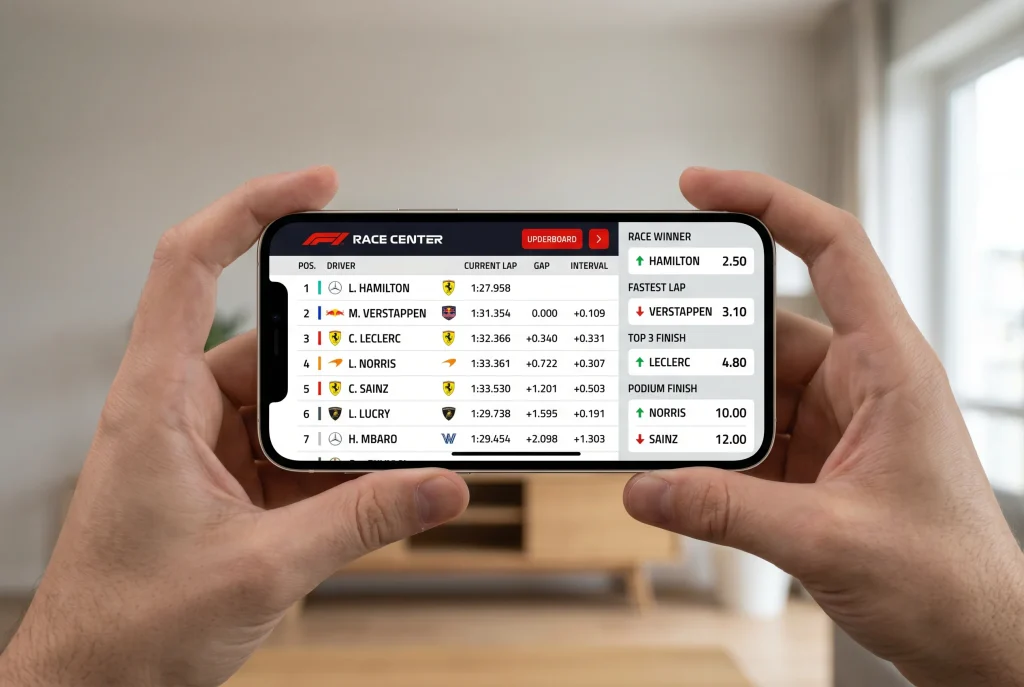
What makes an F1 app different from a generic sports app
The first time I tried to place a fastest-lap bet on my phone during the closing stages of the 2024 Brazilian Grand Prix, the app I was using needed seven taps to get from home screen to confirmation. By the time I finished tapping, the price had moved from 6/1 to 9/2. That moment taught me more about F1 mobile apps than any reviewer’s checklist ever could.
Generic sports apps are built around football. Football is a 90-minute object with two teams and a small number of recurring markets. F1 is a 90-minute object with twenty drivers, ten teams, four different stints, three tyre compounds, a moving safety-car probability, and dozens of micro-markets that open and close as the race develops. The information density is roughly five times higher, and any app that does not acknowledge this will feel sluggish on a Grand Prix Sunday.
A good F1 app surfaces what matters in the current race phase. During the opening laps that means first-lap markets and pole-conversion plays. Mid-race it means undercut and pit-window prices. Final stint it means cash-out values and fastest-lap angles. Generic apps treat every minute of the race identically, which is exactly why they feel slow when the race actually starts moving. Around 13.5 million people in the UK now hold an active online gambling account on average each month, and a significant slice of them place at least some of their motorsport wagers from a phone — yet most apps still treat F1 as a niche tab buried two levels deep.
Best F1 Betting Apps for UK Mobile Users — More on this topic at where to bet on f1.
Core App Features F1 Punters Need
I rate F1 apps the way pit-wall engineers rate strategy software: by how quickly it lets me make a good decision under time pressure. The cosmetic layer almost never matters. What matters is the path from “I want this bet” to “stake confirmed”.
The first feature I check is market depth on a single screen. Can I see the race-winner price, the podium market, the safety-car yes/no, and the head-to-head matchup for a specific teammate pair without leaving one view? If the app forces me to back out into a menu between markets, it adds a tap and a load time to every comparison. Over the course of a Grand Prix that costs me actual money in missed price moves.
The second feature is the in-play refresh rate. F1 prices move fast — particularly after qualifying, when overnight prices recalibrate to grid positions and weather forecasts. An app that pulls fresh odds every fifteen seconds is acceptable. One that refreshes every thirty seconds is too slow for live decisions but fine for pre-race planning. I have used apps that visibly lag the broadcast feed by more than a lap; those are unusable when the race is moving.
The third is bet slip persistence. If I half-fill a complex bet builder — say four legs across a Sprint Saturday — and switch apps to check live timing, the slip should still be there when I come back. Apps that wipe the slip on backgrounding force you to rebuild from scratch, and rebuilding under time pressure is where mistakes happen. Around 21% of online gamblers in the UK already place live bets during events; among 18 to 24 year-olds that figure climbs to 37%, which tells you everything about who these apps need to be designed for.
The fourth, and the one most apps get wrong, is the responsible-gambling layer. Deposit limits should be reachable in two taps from anywhere in the app, not buried in a settings labyrinth. Time-out and self-exclusion controls should be equally accessible. UKGC-licensed operators are required to offer these tools, but the quality of the implementation varies sharply.
Live Timing and Stream Integration
Here is the thing nobody tells you: live timing is more useful than live video for F1 betting. The TV director shows you what makes good television. Live timing shows you what makes good betting decisions. Sector splits, tyre age, gap delta — that is the data that moves markets, and the broadcast camera does not show it.
A handful of UK apps now integrate either F1 TV embeds or limited live timing data inside the betting interface. The integration quality is mixed. The best implementations let you see a driver’s gap to the car ahead and a tyre-age indicator without leaving the bet screen. The worst ones link out to a separate browser window, which defeats the point.
If your app does not integrate live timing, the workaround is simple: run the F1 official live timing on one phone and the betting app on another, or use a tablet for timing and the phone for bets. This is a clunkier setup but it gives you a meaningful information advantage over punters relying on the TV feed alone. Sky Sports F1’s 2025 season pulled 162 million viewer-hours of UK and Ireland viewing, and the under-35 audience grew 120% since 2019 — most of those new viewers came in mobile-first, and they are exactly the people who would benefit most from running timing data alongside the broadcast.
Notifications That Actually Matter
The default notification setup on most betting apps is a marketing-driven disaster. I have seen apps push me three promotional messages on a Saturday morning and then go silent on Sunday when the race actually starts. The solution is to disable everything by default and then turn on only the alerts that change my behaviour.
For F1, three alert types earn their place on my phone. The first is grid-penalty confirmation, because a penalty announced after pricing changes the value calculation immediately. The second is final-practice long-run pace summaries, where the app has them. The third is significant price-movement alerts on any selection I have flagged. Everything else is noise.
iOS Versus Android: Real Differences
The biggest practical difference between iOS and Android F1 betting apps is not aesthetic. It is the App Store policy. Apple’s gambling guidelines force operators through more verification hoops, which often means a slightly trimmed feature set on iOS compared to the Android equivalent. Some bet builder configurations and certain promotional offers are Android-only because Apple’s review process has flagged them.
Battery management is the second real difference. Live-betting apps with high-frequency refresh chew through battery during a two-hour Grand Prix. iOS handles background refresh more aggressively than stock Android, which means iPhone users sometimes find their slip times out faster when the app is backgrounded. Conversely, Android phones running constant odds refresh visibly drain faster across a race weekend.
A 90-Second App-Testing Checklist
Before I commit to using a new F1 betting app for a full season, I run a short test on a non-race weekend. The whole thing takes ninety seconds and tells me almost everything I need to know.
See also F1 Bet Builder Tools Compared.
I open the app cold and time how long it takes to reach the F1 race-winner market from launch. Anything over twelve seconds fails the test. Then I tap into a head-to-head market and check whether the qualifying head-to-head and race head-to-head sit on the same screen or require backing out. Then I check the in-play tab to confirm that markets exist for in-play F1, not just pre-race. Many apps still treat F1 as a pre-race only product, and that is a disqualifying flaw if you want to bet during the race.
Finally I open the bet slip with a dummy selection, background the app for thirty seconds, and reopen it. If the slip is still there, the app passes. If it is empty, I delete the app. This last check is the one that filters out about half the apps I have tested over the last two seasons.
The mobile F1 punter has different needs to the desktop punter, and the apps that recognise this — fast load, integrated timing where possible, persistent slips, sensible notifications — are the ones worth keeping installed. The rest get deleted by mid-season. For more on what happens once you have your bet placed and the race is running, see my breakdown of how cash-out actually works on F1 bets.
Written by the editors at Apexodd.
