
Wet Weather F1 Betting Tactics: When the Rain Changes the Maths
 Available in US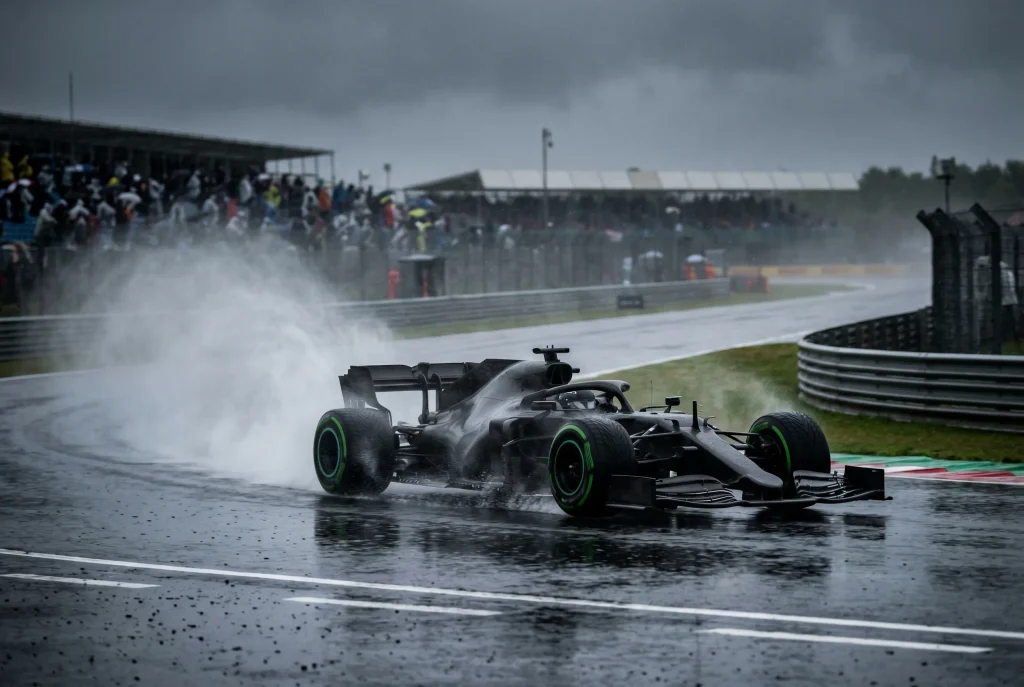
Rain rewrites the form book within minutes
I have seen a race-winner price move from 1.8 to 4.5 in under ten minutes because the meteorological radar flipped from yellow to red. Wet weather is the single biggest market-moving variable in F1 betting. Every other factor — driver form, car upgrades, circuit characteristics — gets rewritten when the rain starts falling. The punters who profit from wet races are the ones who have already done their thinking before the weather forecast updates.
The £596 million UK real-event betting handle in the most recent quarter, up 5% year-on-year, includes a meaningful spike in volume on wet-weather race weekends. Operators see the volume and respond — wet-race pricing is more cautious than dry-race pricing because the liability range is wider. The 21% of UK online gamblers who place live bets, rising to 37% among under-25s, are the audience that wet weather rewards most.
Wet Weather F1 Betting Tactics — More on this topic at where to bet on f1.
The two phases of a wet race — and the two pricing windows
Every wet F1 race splits into two phases: the conditions-driven phase, where rain intensity determines positions, and the recovery phase, where the dry pace reasserts itself if the rain eases. The betting market behaves differently in each phase. The first phase produces price extremes — favourites lengthen to 3.0 or 4.0, longshots shorten to 8.0 or 10.0. The second phase compresses the prices back toward the dry-weather expectation as soon as the conditions stabilise.
The punter’s task is timing. The market overreacts to the first signs of rain — the price moves are larger than the change in true probability warrants. The market then under-reacts when the rain eases — the prices stay long on the favourites for a few minutes after the conditions justify shortening. Both pricing inefficiencies are exploitable if you can act faster than the operator’s modelling refreshes.
Which drivers genuinely shine in the wet
The “rain-master” label gets applied liberally in F1 commentary, often to drivers who simply happened to win one notable wet race. The actual data is narrower than the reputation. Across recent seasons, a small group of drivers have demonstrated a measurable wet-versus-dry pace differential that exceeds the field median:
- Drivers with high-downforce car platforms gain less in the wet, because the relative advantage compresses
- Drivers with low-downforce car platforms gain more in the wet, because the rain equalises straight-line performance
- Drivers with strong feel for low-grip conditions (judged by car-control telemetry) typically deliver wet-pace bumps of 0.5 to 1.0 seconds per lap relative to the field
- Drivers with weaker tyre management can sometimes overperform in fully wet conditions, because the management advantage disappears at low grip
The list of drivers who genuinely belong to the “wet specialist” category is shorter than the betting public assumes. Pricing premium on the assumed wet specialists is usually overdone; pricing on the genuine wet specialists is usually closer to fair. The work is separating the two.
The weather forecast as a betting tool
Three forecast sources give meaningful inputs to wet-race betting decisions. The official UK Met Office forecast for European rounds. The track-specific forecast published by the circuit and F1 itself. And the high-resolution rainfall radar that updates every five to fifteen minutes during the race weekend. Each has a different update frequency and a different reliability window.
The radar is the most actionable input in-play. A live rain cell visible 20 km upwind of the circuit will reach the track within 10 to 20 minutes — that window is enough time to act on price movements before the operator’s modelling catches up. The radar update is publicly available; the operator’s modelling is not. The asymmetry is the punter’s edge.
The pre-race forecast is more useful for setting up positions than for in-race trades. A Saturday-evening forecast showing 60% rain probability for Sunday afternoon is the cue to back the wet specialists at pre-race prices, not to wait for live confirmation. By the time live confirmation arrives the prices have already moved.
Safety car probability in wet conditions
The 2025 season had three drivers winning seven races each, decided by a two-point countback at the final round — and a meaningful share of those swings came from wet-race incidents and the safety cars that followed. Wet races produce safety car deployments at roughly double the dry-race rate. The “safety car yes” market in wet conditions is one of the most consistently underpriced bets in F1.
The implication for race-winner pricing is that the wet-race outcome carries more strategic variance than the dry-race outcome. A safety car at lap 30 of 60 in a wet race resets the gaps, eliminates the tyre-life advantage held by drivers who pitted later, and produces overtaking opportunities at the restart. The drivers who do well in this chaos are not always the same drivers who win in clean wet conditions.
Pre-race versus in-play in wet weather
Pre-race wet-weather bets are a forecast play. You are betting on the rain occurring and on the specific driver capitalising on it. The price reflects both probabilities, and the variance is high. In-play wet-weather bets are a condition-confirmed play — the rain is actually falling, so you are betting only on the second probability, with the first already settled.
The trade-off is the price. Pre-race wet specialists at decimal 8.0 or 10.0 sometimes become decimal 4.0 once the rain starts. The 50% price compression reflects the resolution of the weather uncertainty. Whether the pre-race or in-play angle is better depends on how confident you are in the forecast at the pre-race window. A 70% rain probability justifies pre-race positioning; a 30% probability does not.
The 78% of F1 fans wanting more Sprint rounds will see six Sprint weekends in 2026 — double opportunities for wet-weather betting, because both the Sprint and the main race can be affected. Sprint-format weekends often produce more weather variance than conventional weekends, because the compressed schedule offers fewer opportunities for the conditions to stabilise.
The cash-out decision in a wet race
Cash-out values in wet races move faster than in dry races. A bet you placed pre-race at decimal 5.0 can show a cash-out value of decimal 1.5 within ten laps if the rain starts and your driver capitalises. The temptation to cash out at 1.5 is enormous; the discipline to hold for the full result is what separates the disciplined punters from the rest.
The cash-out is a partial trade — you exchange the residual probability for a guaranteed return. In a wet race, the residual probability is more volatile than in a dry race. The price you cash out at this minute might be 30% better or 30% worse three laps later. The market knows this and prices cash-out accordingly, with margins on cash-out values typically 5% to 10% wider in wet conditions than in dry.
What I do when the radar flashes red
My personal wet-race protocol is short. Check the radar resolution before placing any bet. Identify the genuine wet specialists for the current car generation, not the reputation-based ones. Bet small stakes pre-race when the forecast is uncertain, larger stakes in-play when the conditions are confirmed. Take the safety-car yes market as a separate position when the rain is heavy. And track the result regardless of outcome — wet races are high-variance, and one weekend’s data is not enough to validate the approach.
See also Countback Rule in F1 Outrights.
For the complementary side of how race conditions interact with the in-running market, see my analysis of safety car betting markets in F1, which extends the wet-weather safety-car angle into a standalone market type.
Prepared by the Apexodd editorial staff.
